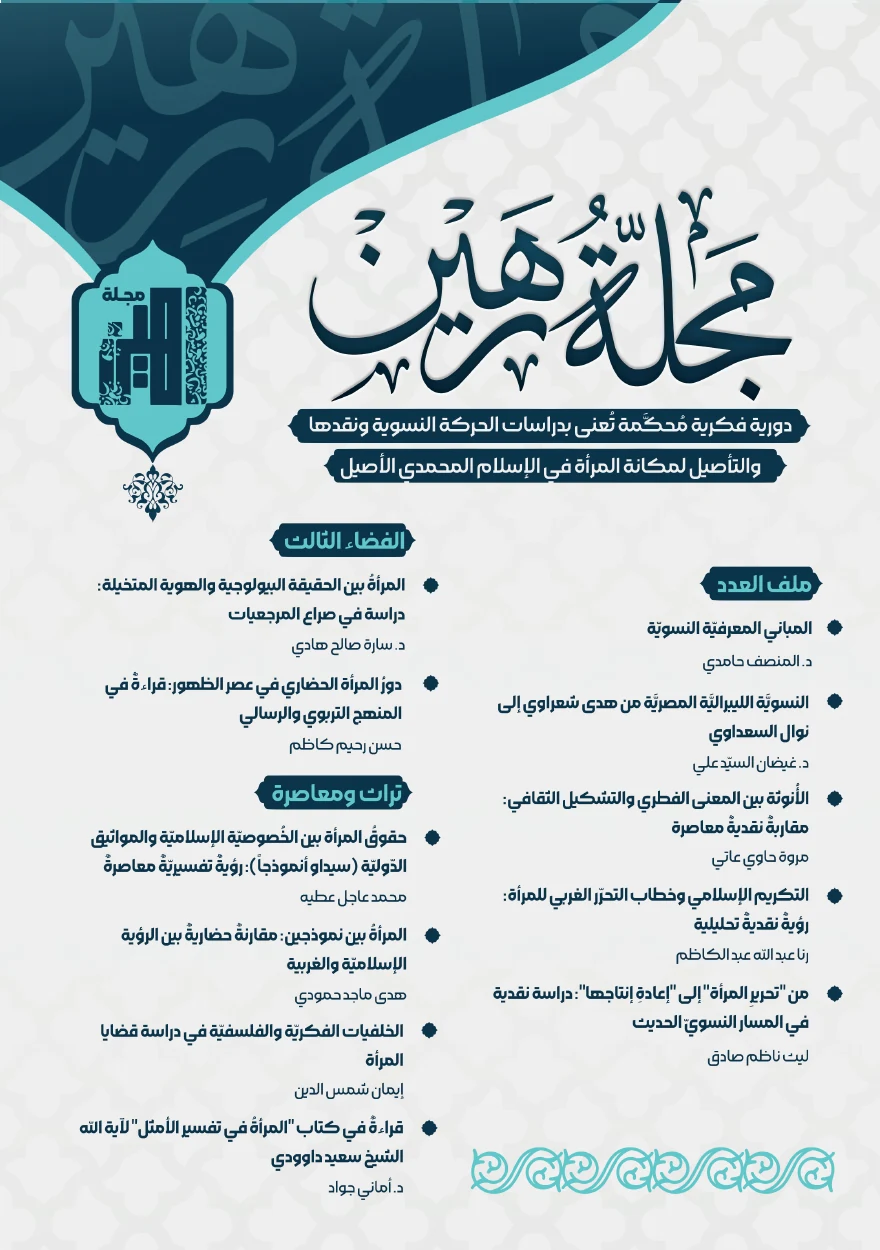
Women and the Question of Foundations: From Producing Knowledge to Building Identity
Dr. Nadine Yahfoufi
Editorial
Editor-in-Chief, Dr. Nadine Yahfoufi
Women’s issues lie at the heart of contemporary intellectual and social debate. They are directly connected with how people understand themselves, what they mean by innate disposition (fitra), freedom, justice, dignity and family, and what they take to be society’s purpose. Differences in how people address these issues often begin with epistemological and philosophical foundations. These shape what it means to be human, where value comes from, the limits of nature and how embodiment relates to identity, and rights to responsibility. Differences in judgments and conclusions follow from those foundations.
We have particular reason to revisit these questions as definitions of womanhood change rapidly and concepts become sites of cultural contestation. Terms such as “liberation,” “equality,” “femininity,” “gender” and “identity” do not always mean the same thing. Their meanings are inseparable from the intellectual and historical settings in which they emerged. Asking what rights women should enjoy is essential. A question comes before it: what understanding of human beings, knowledge and value informs how we define those rights and their purposes?
This second issue of Rahin, published by the Sadad Islamic Center for Strategic Studies, continues an intellectual project concerned with women, the family and identity. It studies feminist discourses and scrutinizes their foundations and consequences from an Islamic frame of reference and in accordance with the demands of rigorous scholarship.
The project takes contemporary questions seriously, acknowledges the real injustices women have experienced in different settings and examines imported models critically. It seeks a considered position that distinguishes justified demands for rights from the ideological frames in which those demands may be presented. It examines where concepts come from, how they change and how they affect individuals, families and societies.
The main research section asks about the structure of feminist knowledge itself. Is feminism a school of thought, an ideology or a social and political movement with multiple tendencies? Can we speak of “feminist knowledge” with its own conception of the knowing subject, sources and standards, in response to what some feminist schools describe as the dominance of
male-centered knowledge? Such questions show that debates about feminism extend beyond social demands to the concept of knowledge, claims to neutrality and the relationship between the researcher and the subject of study.
The issue proceeds from theoretical foundations to their expression in history. It traces Egyptian liberal feminism from Huda Shaarawi to Nawal El Saadawi and considers the movement between social reform and radical critiques of cultural and religious structures. This approach helps assess the role of colonial conditions and Western ideas in shaping Arab feminist discourse and identify both continuity and change across its stages.
The research section also asks how femininity takes shape through innate disposition and cultural formation. Biology alone cannot explain the variety of human experience or the influence of history, upbringing and social institutions. An exclusively cultural account, meanwhile, overlooks the place of the body and innate disposition in forming identity. An integrated approach can move beyond biological and cultural determinism by examining how physical, psychological, social and moral dimensions interact.
Studies in this issue compare the Islamic principle of honoring women with versions of Western liberation discourse and consider the distance between theoretical promises and social outcomes. The removal of inherited constraints does not always bring fuller freedom. One form of marginalization can give way to consumer, media and digital practices that assign value and recognition on the basis of the body, image and purchasing power. We must ask what kind of freedom is being proposed, what conception of humanity it leads to and whether it safeguards women’s dignity and psychological and social well-being.
Heritage and Modernity turns to the relationship between Islamic authority and contemporary human rights frameworks. The Convention on the Elimination of All Forms of Discrimination against Women (CEDAW) illustrates tensions between the universal claims of rights discourse and the distinctiveness of cultural and religious traditions. The issue looks beyond outright rejection and unconditional acceptance. It distinguishes common moral principles from disputed philosophical foundations, and settled tenets of belief and law from matters open to independent reasoning and reconsideration.
The section also compares Islamic and Western views of women and examines how Islam transformed women’s lived conditions, their standing as persons and their legal status. Recovering an Islamic frame of reference involves more than citing texts. It requires distinguishing revelation from historical applications and religious rulings from social custom. It also requires examining how juristic reasoning shapes ideas about women and defines their rights and roles. In this view, the inherited tradition remains open to reexamination. Contemporary life cannot be the final authority
against which values are judged without scrutiny. Sound knowledge comes from reading texts, history and contemporary realities through a method that respects established principles and leaves room for responsible independent reasoning.
The Third Space section explores ways past entrenched polarization. It retains a clear frame of reference while reframing the questions for analysis. One study looks at the conflict between biological reality and imagined identity. It cautions against a complete separation of body and identity and against reducing women to biology. Another study moves from protecting identity to considering women’s role in civilization. It examines women’s educational work and religious mission in the era of the Mahdi’s appearance, including their part in shaping human beings, safeguarding awareness, striving to convey the truth clearly and preparing for a just society.
A reading of Ayatollah Shaykh Saeed Davoudi’s Women in the Tafsir al-Amthal brings contemporary questions into conversation with Qur’anic exegesis. It considers how women’s issues arise when interpreting the Qur’an and deriving its understanding of human beings, family and society. The readings section provides a space to assess research critically, examine its methods and incorporate it into ongoing scholarly dialogue.
This issue aims to map the epistemological, historical, legal and civilizational dimensions of the questions it raises. Its contributors reach different judgments and take different approaches. They share an understanding that women’s individuality and agency should not dissolve in custom and that women should not be reduced to bodies, images or identities open to unlimited reconstruction in the name of liberation.
Honoring women in Islam calls for research, responsible independent reasoning and reform. It begins with affirming women’s human dignity, removing injustices they face, preserving their innate disposition, recognizing their agency and fostering just complementarity in family and society. Rahin offers this second issue to readers and researchers in support of measured scholarly dialogue. We hope inquiry into contemporary questions can proceed with awareness and confidence, that critique can contribute to constructive work, that a living tradition can inspire creativity and that knowledge can serve humanity and truth.
Issue 2Moncef Hamdi
This article seeks to address a series of questions concerning feminism. The first set of questions falls within the domain of defining the nature of feminism. It encompasses a range of inquiries intended to illuminate the concept of feminism itself, with the aim of dispelling misconceptions and removing obstacles to a more accurate understanding of the feminist phenomenon. Accordingly, the article first examines whether feminism should be understood as an intellectual current, comparable to liberalism or socialism, or rather as an ideology. Within this initial framework, the discussion proceeds to explore whether feminism is fundamentally a social movement, a political movement, or a purely intellectual enterprise. Addressing this question provides the basis for entering the second framework of the study, namely the principal features of feminist epistemology. The analysis proceeds from the premise that feminism advances a distinctive conception of knowledge that differs fundamentally from mainstream epistemological theories. Feminist scholars argue that dominant epistemology is inherently androcentric and therefore fails to accommodate women’s aspirations to attain their rightful status within society. To achieve this objective, feminism maintains that it is necessary to ground knowledge in an epistemological framework capable of responding to these aspirations, generating productive forms of knowledge, and facilitating rather than hindering the realization of women’s goals. Accordingly, the construction of a more equitable conception of women begins with transcending the dominant epistemic framework, which is viewed as androcentric and as one of the principal obstacles to the achievement of feminist objectives. From this perspective, if the defense and empowerment of women constitute the supreme aim of the feminist movement, then realizing this aim requires, first and foremost, the removal of the epistemic barriers that impede its fulfillment. Feminism therefore regards overcoming the epistemological constraints embedded in dominant theories of knowledge as the cornerstone for achieving its objectives. Consequently, it advocates the development of a feminist epistemology capable of transcending the epistemic limitations produced by prevailing androcentric conceptions of knowledge. Perhaps the central question posed by feminist epistemology is: Who is the subject of knowledge? Is the knower assumed to be male, thereby reinforcing dominant epistemology, or female, thereby giving rise to a distinctively feminist epistemology? This article seeks to explore the epistemological foundations upon which such feminist knowledge is constructed.
Issue 2Ghaydan al-Sayyid Ali
This study highlights the evolution of feminist thought in Egypt across two distinct historical periods. It seeks to examine the relationship between liberal feminism and its social and political context, analyze the transition from gradual reformism to radical critique, and shed light on the contributions of two of the most influential figures in Egyptian and Arab feminist thought. The study also explores the extent to which their ideas were shaped by external intellectual influences, arguing that Huda Sha’arawi’s early feminist project was influenced by Western colonial thought, whereas Nawal El Saadawi’s work reflects the impact of contemporary radical feminist currents. Against this background, the central research question is: How did liberal feminism in Egypt evolve from the phase of social and political reform represented by Huda Sha’arawi to the phase of radical criticism of cultural and religious structures represented by Nawal El Saadawi? From this overarching question arise several subsidiary questions: What is the nature of liberal feminism within the Egyptian context? Is there a relationship between the Egyptian liberal feminist movement and colonialism? To what extent did liberal feminism in Egypt become dependent upon Western feminist movements? To what degree does Nawal El Saadawi’s feminist project represent a continuation of Huda Sha’arawi’s vision, and to what extent does it constitute an epistemological and methodological rupture with it? What are the principal similarities and differences between the two projects? How did their respective historical contexts shape their intellectual discourse? Finally, what are the limitations of each experience and its contribution to Arab feminist thought? To address these questions, the study is organized into an introduction outlining the significance of the research, its rationale, central problem, research questions, thematic structure, and methodological approach, followed by three main sections. The first examines the concept of liberal feminism within the Egyptian historical context. The second discusses Huda Sha’arawi and the establishment of a colonial-supported liberal feminist project. The third analyzes Nawal El Saadawi and critical liberal feminism. The conclusion summarizes the principal findings of the study. The research employs four principal methodological approaches. The analytical method is used to examine the writings of Huda Sha’arawi and Nawal El Saadawi in order to identify the underlying objectives of their thought. The comparative method is employed to identify areas of convergence and divergence between their respective perspectives. The critical method provides a systematic evaluation of liberal feminist arguments, particularly where they depart from established religious and social norms. Finally, the historical method traces the development of liberal feminism in Egyptian society over approximately a century.
Issue 2Marwa Hawi Ati
The study addresses the problematic concept of femininity as a complex concept in which the biological national boundary overlaps with the socio-cultural dimension, in an attempt to understand the nature of this concept and the limits of its formation in different human contexts. This study aims to clarify the problematic nature of the concept of femininity by deconstructing traditional perceptions that confine it to stereotypical roles or ready-made attributes, and by analyzing how the social image of femininity is produced and reproduced within society. It also seeks to demonstrate the dialectical interaction between what is considered innate and what is culturally acquired in shaping women’s identity. Furthermore, it endeavors to offer a contemporary technical reading that helps in understanding femininity as a dynamic concept, subject to transformation according to historical and social trends. The study adopts the critical analytical method as the most appropriate methodological framework for deconstructing and interpreting concepts, in addition to utilizing the socio-cultural approach in analyzing discourses that contribute to the construction of social perceptions of femininity. The study arrives at a number of conclusions, the most important of which is that femininity cannot be reduced to its biological dimension alone, but is rather the product of a complex interaction between nature and culture. Cultural formation plays a pivotal role in determining the meanings of femininity and its social roles, leading to differences in its representations from one society to another. It also reveals that many traditional social discourses contribute to perpetuating images Stereotyping limits the diversity of female experience, while contemporary approaches tend to view femininity as an open, dynamic, and reshaping identity, calling for a more flexible and humanistic vision that respects multiculturalism and moves away from reductionism and singular definition.
Issue 2Rana Abdullah Abd al-Kadhim
This research examines the relationship between two different intellectual frameworks regarding women’s issues: the Islamic system, based on the principle of comprehensive human dignity, and the Western system, built on the discourse of feminist liberation. The study begins by analyzing the extent to which the Western discourse on liberation has contributed to improving the reality of women, or whether it has merely reproduced new forms of marginalization under different names and concepts. The study aims to clarify the doctrinal and ethical foundations upon which the respect for women in Islam is based, to trace the historical development of the Western discourse on liberation, and to analyze its philosophical and social problems. Furthermore, it conducts a critical comparison between the two systems on important issues such as identity, family, and equality. The study employs a critical, analytical, and comparative approach to examining texts and concepts. It concludes that the Islamic system presents a comprehensive vision for women that preserves their dignity and balances their human and social rights and roles. In contrast, it reveals structural contradictions within Western discourse that limit its ability to achieve the human fulfillment it claims. The study’s findings are embodied in the presentation of a sound scientific approach based on a balanced and critical dialogue with Western thought, avoiding defensive or emotional responses.
Issue 2Layth Nazim Sadiq
This study critically analyzes the intellectual and social transformations witnessed by modern feminist discourse, starting from the concept of «women’s liberation» as a reformist project that sought to promote women’s rights and raise their levels of social, political, and economic participation, leading to what can be described as the «reproduction of women» within new cultural and consumer patterns that have reshaped their image and function within contemporary society. The study aims to analyze the intellectual concept of women’s liberation in modern feminist literature, trace the historical and philosophical transformations of contemporary feminist movements, and reveal the mechanisms of reproducing the image of women in modern media, cultural, and consumer discourse. In addition, it aims to clarify the relationship between modern feminism, capitalist transformations, and digital culture, leading to a balanced critical reading that distinguishes between legitimate rights gains and intellectual and social problems Based on some contemporary applications, the study adopted a descriptive-analytical approach and reached a number of conclusions, most importantly that modern feminism is not a single intellectual current, but rather encompasses multiple and diverse trends in its vision of the concept of freedom and the role of women within society. The results also showed that some contemporary applications of feminist discourse have unintentionally contributed to reinforcing consumerism and linking the value of women to standards of image, body, and media representation, which has led to the emergence of new forms of psychological and social pressures.
Issue 2Muhammad Ajil Atiyah
This study investigates the ongoing dialectic between the Islamic cultural and legislative framework and the international human rights regime, taking the Convention on the Elimination of All Forms of Discrimination against Women (CEDAW) as its analytical model. It aims to present a contemporary interpretive perspective that deconstructs the epistemological tension between the concepts of the «universality of rights» and the «particularity of identity.» This is achieved through an examination of the liberal philosophical foundations upon which international conventions are based and a comparative analysis of the higher objectives (Maqāṣid) of Islamic law concerning women. The study critiques the polarized dichotomy that confines the relationship between these two frameworks to either absolute rejection, driven by concerns over cultural and religious identity, or unconditional acceptance detached from the normative values of Muslim societies. It examines the areas of convergence and divergence, particularly with respect to personal status law and procedural equality, while providing a careful analysis of the legitimacy of reservations to international conventions and their legal and Sharīʿah-based justifications. Employing a comparative analytical methodology, the study explores the possibilities for harmonization through the activation of maqāṣid-oriented ijtihād, which distinguishes between immutable doctrinal principles and mutable juristic rulings shaped by historical customs and social contexts. The study concludes by emphasizing the necessity of formulating an alternative human rights discourse that moves beyond confrontation toward an integrative conception of rights—one that safeguards women’s dignity within a framework that reconciles the demands of modern legal systems with the principles of Islamic authenticity. It further argues that cultural pluralism should be respected as an inherent right within the universal human rights framework.
Issue 2Huda Majid Hammoudi
This study aims to examine the image and status of women in both the Islamic and Western perspectives by analyzing the intellectual, philosophical, and legislative foundations upon which each perspective is based, and by exploring their implications for the contemporary reality of women. The significance of the study stems from the growing civilizational debate surrounding women’s issues and the related concepts of freedom, equality, identity, and social role, particularly in light of the increasing influence of globalization and contemporary cultural transformations. The study adopts both the descriptive-analytical and comparative approaches. Its findings indicate that the Islamic perspective is founded upon the principle of honoring women as human beings, recognizing them as partners with men in human responsibility and religious obligation while taking into account their innate characteristics and the principle of functional complementarity within the family and society. The study also demonstrates that Islam granted women civil, social, and economic rights at an early stage compared with many other civilizations, while maintaining a balance between individual freedom and family stability. Furthermore, the study shows that the modern Western perspective has undergone successive transformations in its understanding of women. It began with efforts to overcome historical marginalization and gradually evolved into movements advocating absolute equality and the redefinition of traditional social roles. While some of these developments have contributed to enhancing women’s participation in public life, they have also generated challenges in certain societies, including family disintegration, psychological pressures, and the commodification and media exploitation of women’s image.
Issue 2Iman Shamseddin
Building upon the line of inquiry initiated in the first part of this study, published in the previous issue, this second part explores the evolution of the status of women from the pre-Islamic era (Jāhiliyyah) to the advent of Islam. As the final divine religion completing the mission of the preceding revealed faiths, Islam sought, through the centrality of its prophetic message, to establish justice and fairness not only at the level of legislation but also in its implementation and practical realization within both the inner and outer dimensions of human life. Women were among the principal beneficiaries of these fundamental reforms, which transformed numerous prevailing customs, traditions, and deeply entrenched assumptions. These reforms laid the foundations for a comprehensive framework that defined the nature of women’s identity in Islam in both its theoretical and practical dimensions through the revealed texts, namely the Holy Qur’an and the transmitted teachings of the Prophet Muhammad (peace and blessings be upon him and his Family) and the Imams of his Ahl al-Bayt (peace be upon them all). Their lived practice constituted the practical embodiment of Islamic principles in social reality, particularly with regard to the legal and essential status of women, both as individuals and within their familial and social relationships, as well as the nature of their roles and the rights and responsibilities arising therefrom. The study further examines the role of Islamic juristic reasoning (ijtihād) and its intellectual and historical contexts in shaping the understanding of women’s position in Islam through juristic rulings (fatwas). It also highlights the scholarly critiques that have contributed to the development and refinement of Islamic jurisprudential thought concerning the status of women in particular.
Issue 2Sara Salih Hadi
This study addresses the issue of women between the determinants of biological reality and the transformations of imagined identity. It does so by analyzing the conflict between biological, social, cultural, and intellectual frameworks that have helped reshape the concept of woman and her role in contemporary societies. The study aims to reveal the impact of modern intellectual shifts on redefining the concept of woman, in addition to analyzing the repercussions of feminist and postmodern discourses on the value and social structure of the family and society. It also sought to clarify the boundaries of overlap between what is innate and what is acquired in the formation of human identity, while highlighting the philosophical and social problems that have resulted from this overlap. The study adopted a descriptive-analytical approach and reached a number of conclusions, the most important of which is that the complete separation between biological reality and social identity leads to epistemological and value-based problems that affect the stability of the social structure and the balance of human roles. The results also showed that some contemporary approaches have exaggerated the interpretation of identity as a purely social construct, ignoring the impact of biological formation on shaping human characteristics. Conversely, the study showed that reducing woman to her biological dimension alone leads to the marginalization of her human, cultural, and social dimensions.
Issue 2Hasan Rahim Kadhim
This study explores the strategic dimensions of the civilizational role assumed by women in the Era of the Reappearance, moving beyond conventional perspectives that confine their presence to marginal or merely subordinate roles. It aims to elucidate the philosophy of women’s mission-oriented empowerment within the global Mahdist project, presenting women as active and integral partners in bringing about comprehensive moral and social transformation. The study is based on the premise that the Era of the Reappearance represents the pinnacle of human empowerment, in which women emerge as educational leaders and bearers of the divine message, contributing to the consolidation of the State of Divine Justice through the formation of morally and spiritually qualified individuals capable of cultivating the earth in accordance with God’s will. The paper analyzes the educational methodology required to prepare the Mahdist woman, emphasizing the integration of intellectual awareness with spiritual refinement, and demonstrates how such preparation fosters a model of leadership capable of confronting the challenges of an age characterized by moral fluidity. It also examines the mission-oriented approach of women, manifested in their ability to preserve identity and protect the social fabric from cultural infiltration, arguing that their role in the Jihad of Clarification (Jihad al-Tabyin) and in consolidating a value-based system constitutes the cornerstone of civilizational preparation for the Reappearance. The study concludes that the civilizational role of women in the Era of the Reappearance embodies the principle of human complementarity in its highest form. It affirms that the perfection of the human experience on earth can only be achieved through the presence of mission-conscious women who fully comprehend the responsibilities of divine vicegerency (istikhlāf) and the comprehensive Mahdist renaissance.
Issue 2Amani Jawad
Al-Amthal fi Tafsir Kitab Allah al-Munzal, by Ayatollah Shaykh Makarem Shirazi, is among the most prominent contemporary commentaries on the Qur’an. Its clear, accessible language and its combination of exegetical, educational, and social perspectives distinguish the work, which seeks to connect Qur’anic verses to human concerns and the principal needs of the present age. Thematic exegesis is one of the major approaches to interpreting the Qur’an. It brings together verses on a common subject and studies them as part of an integrated account.