
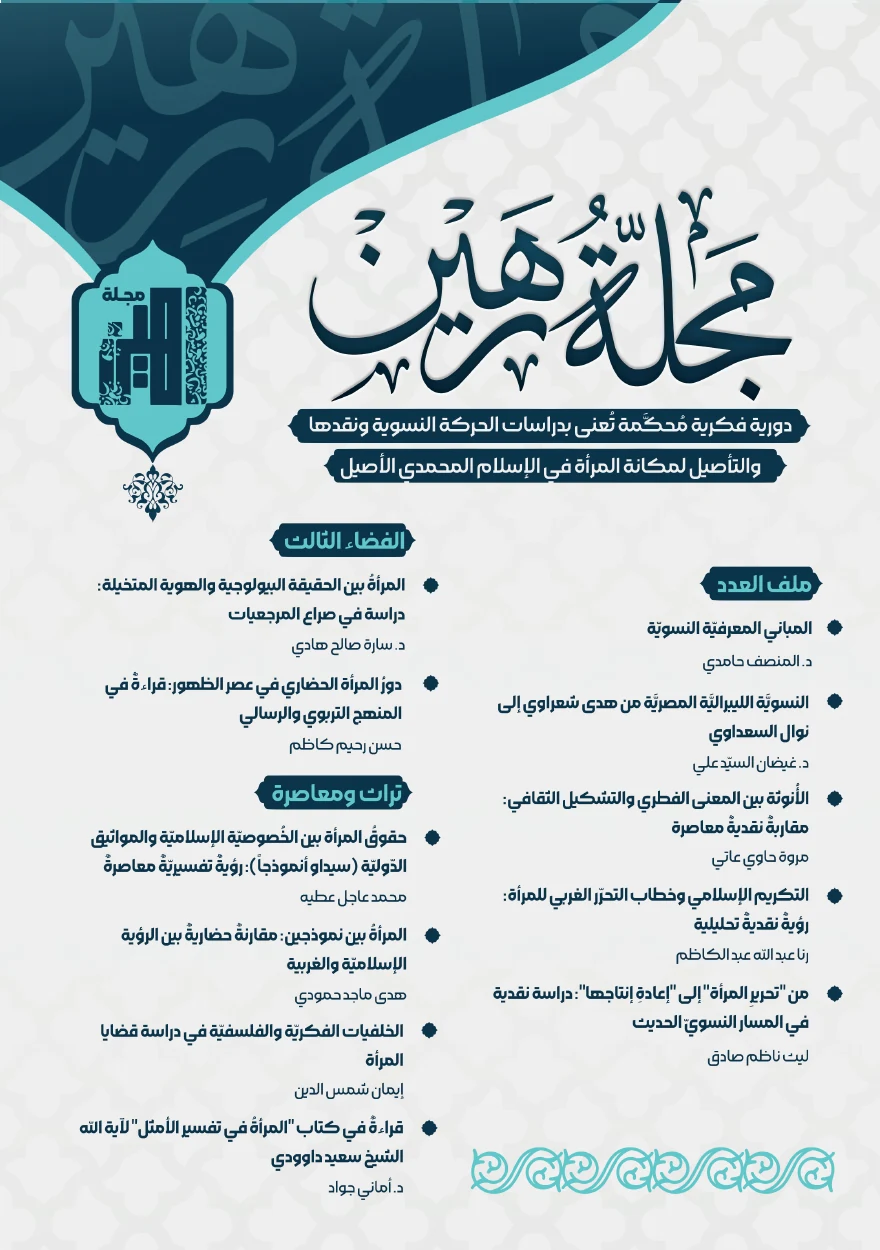
Peer-reviewed journal

Rahin Journal

A journal of women’s studies from an Islamic epistemological perspective.

Current issue

Cover of issue 2 (Arabic)

Issue 2 Summer 2026

Read the issue contents

Journal sections

Readings from the current issue

Issue dossier

Epistemological Foundations of Feminism

Moncef Hamdi

This article seeks to address a series of questions concerning feminism. The first set of questions falls within the domain of defining the nature of feminism. It encompasses a range of inquiries intended to illuminate the concept of feminism itself, with the aim of dispelling misconceptions and removing obstacles to a more accurate understanding of the feminist phenomenon. Accordingly, the article first examines whether feminism should be understood as an intellectual current, comparable to liberalism or socialism, or rather as an ideology. Within this initial framework, the discussion proceeds to explore whether feminism is fundamentally a social movement, a political movement, or a purely intellectual enterprise. Addressing this question provides the basis for entering the second framework of the study, namely the principal features of feminist epistemology. The analysis proceeds from the premise that feminism advances a distinctive conception of knowledge that differs fundamentally from mainstream epistemological theories. Feminist scholars argue that dominant epistemology is inherently androcentric and therefore fails to accommodate women’s aspirations to attain their rightful status within society. To achieve this objective, feminism maintains that it is necessary to ground knowledge in an epistemological framework capable of responding to these aspirations, generating productive forms of knowledge, and facilitating rather than hindering the realization of women’s goals. Accordingly, the construction of a more equitable conception of women begins with transcending the dominant epistemic framework, which is viewed as androcentric and as one of the principal obstacles to the achievement of feminist objectives. From this perspective, if the defense and empowerment of women constitute the supreme aim of the feminist movement, then realizing this aim requires, first and foremost, the removal of the epistemic barriers that impede its fulfillment. Feminism therefore regards overcoming the epistemological constraints embedded in dominant theories of knowledge as the cornerstone for achieving its objectives. Consequently, it advocates the development of a feminist epistemology capable of transcending the epistemic limitations produced by prevailing androcentric conceptions of knowledge. Perhaps the central question posed by feminist epistemology is: Who is the subject of knowledge? Is the knower assumed to be male, thereby reinforcing dominant epistemology, or female, thereby giving rise to a distinctively feminist epistemology? This article seeks to explore the epistemological foundations upon which such feminist knowledge is constructed.

Open article55 min read

Published research

English abstracts are available here. A full English translation is shown where one has been prepared.

Epistemological Foundations of Feminism

Read abstract

This article seeks to address a series of questions concerning feminism. The first set of questions falls within the domain of defining the nature of feminism. It encompasses a range of inquiries intended to illuminate the concept of feminism itself, with the aim of dispelling misconceptions and removing obstacles to a more accurate understanding of the feminist phenomenon. Accordingly, the article first examines whether feminism should be understood as an intellectual current, comparable to liberalism or socialism, or rather as an ideology. Within this initial framework, the discussion proceeds to explore whether feminism is fundamentally a social movement, a political movement, or a purely intellectual enterprise. Addressing this question provides the basis for entering the second framework of the study, namely the principal features of feminist epistemology. The analysis proceeds from the premise that feminism advances a distinctive conception of knowledge that differs fundamentally from mainstream epistemological theories. Feminist scholars argue that dominant epistemology is inherently androcentric and therefore fails to accommodate women’s aspirations to attain their rightful status within society. To achieve this objective, feminism maintains that it is necessary to ground knowledge in an epistemological framework capable of responding to these aspirations, generating productive forms of knowledge, and facilitating rather than hindering the realization of women’s goals. Accordingly, the construction of a more equitable conception of women begins with transcending the dominant epistemic framework, which is viewed as androcentric and as one of the principal obstacles to the achievement of feminist objectives. From this perspective, if the defense and empowerment of women constitute the supreme aim of the feminist movement, then realizing this aim requires, first and foremost, the removal of the epistemic barriers that impede its fulfillment. Feminism therefore regards overcoming the epistemological constraints embedded in dominant theories of knowledge as the cornerstone for achieving its objectives. Consequently, it advocates the development of a feminist epistemology capable of transcending the epistemic limitations produced by prevailing androcentric conceptions of knowledge. Perhaps the central question posed by feminist epistemology is: Who is the subject of knowledge? Is the knower assumed to be male, thereby reinforcing dominant epistemology, or female, thereby giving rise to a distinctively feminist epistemology? This article seeks to explore the epistemological foundations upon which such feminist knowledge is constructed.

Open the article page

Egyptian Liberal Feminism: From Huda Sha’arawi to Nawal El Saadawi

Read abstract

This study highlights the evolution of feminist thought in Egypt across two distinct historical periods. It seeks to examine the relationship between liberal feminism and its social and political context, analyze the transition from gradual reformism to radical critique, and shed light on the contributions of two of the most influential figures in Egyptian and Arab feminist thought. The study also explores the extent to which their ideas were shaped by external intellectual influences, arguing that Huda Sha’arawi’s early feminist project was influenced by Western colonial thought, whereas Nawal El Saadawi’s work reflects the impact of contemporary radical feminist currents. Against this background, the central research question is: How did liberal feminism in Egypt evolve from the phase of social and political reform represented by Huda Sha’arawi to the phase of radical criticism of cultural and religious structures represented by Nawal El Saadawi? From this overarching question arise several subsidiary questions: What is the nature of liberal feminism within the Egyptian context? Is there a relationship between the Egyptian liberal feminist movement and colonialism? To what extent did liberal feminism in Egypt become dependent upon Western feminist movements? To what degree does Nawal El Saadawi’s feminist project represent a continuation of Huda Sha’arawi’s vision, and to what extent does it constitute an epistemological and methodological rupture with it? What are the principal similarities and differences between the two projects? How did their respective historical contexts shape their intellectual discourse? Finally, what are the limitations of each experience and its contribution to Arab feminist thought? To address these questions, the study is organized into an introduction outlining the significance of the research, its rationale, central problem, research questions, thematic structure, and methodological approach, followed by three main sections. The first examines the concept of liberal feminism within the Egyptian historical context. The second discusses Huda Sha’arawi and the establishment of a colonial-supported liberal feminist project. The third analyzes Nawal El Saadawi and critical liberal feminism. The conclusion summarizes the principal findings of the study. The research employs four principal methodological approaches. The analytical method is used to examine the writings of Huda Sha’arawi and Nawal El Saadawi in order to identify the underlying objectives of their thought. The comparative method is employed to identify areas of convergence and divergence between their respective perspectives. The critical method provides a systematic evaluation of liberal feminist arguments, particularly where they depart from established religious and social norms. Finally, the historical method traces the development of liberal feminism in Egyptian society over approximately a century.

Open the article page

Femininity Between Innate Meaning and Cultural Construction: A Contemporary Critical Approach

Read abstract

The study addresses the problematic concept of femininity as a complex concept in which the biological national boundary overlaps with the socio-cultural dimension, in an attempt to understand the nature of this concept and the limits of its formation in different human contexts. This study aims to clarify the problematic nature of the concept of femininity by deconstructing traditional perceptions that confine it to stereotypical roles or ready-made attributes, and by analyzing how the social image of femininity is produced and reproduced within society. It also seeks to demonstrate the dialectical interaction between what is considered innate and what is culturally acquired in shaping women’s identity. Furthermore, it endeavors to offer a contemporary technical reading that helps in understanding femininity as a dynamic concept, subject to transformation according to historical and social trends. The study adopts the critical analytical method as the most appropriate methodological framework for deconstructing and interpreting concepts, in addition to utilizing the socio-cultural approach in analyzing discourses that contribute to the construction of social perceptions of femininity. The study arrives at a number of conclusions, the most important of which is that femininity cannot be reduced to its biological dimension alone, but is rather the product of a complex interaction between nature and culture. Cultural formation plays a pivotal role in determining the meanings of femininity and its social roles, leading to differences in its representations from one society to another. It also reveals that many traditional social discourses contribute to perpetuating images Stereotyping limits the diversity of female experience, while contemporary approaches tend to view femininity as an open, dynamic, and reshaping identity, calling for a more flexible and humanistic vision that respects multiculturalism and moves away from reductionism and singular definition.

Open the article page

Islamic Respect for Women and the Western Discourse on Women’s Liberation: A Critical Analytical Perspective

Read abstract

This research examines the relationship between two different intellectual frameworks regarding women’s issues: the Islamic system, based on the principle of comprehensive human dignity, and the Western system, built on the discourse of feminist liberation. The study begins by analyzing the extent to which the Western discourse on liberation has contributed to improving the reality of women, or whether it has merely reproduced new forms of marginalization under different names and concepts. The study aims to clarify the doctrinal and ethical foundations upon which the respect for women in Islam is based, to trace the historical development of the Western discourse on liberation, and to analyze its philosophical and social problems. Furthermore, it conducts a critical comparison between the two systems on important issues such as identity, family, and equality. The study employs a critical, analytical, and comparative approach to examining texts and concepts. It concludes that the Islamic system presents a comprehensive vision for women that preserves their dignity and balances their human and social rights and roles. In contrast, it reveals structural contradictions within Western discourse that limit its ability to achieve the human fulfillment it claims. The study’s findings are embodied in the presentation of a sound scientific approach based on a balanced and critical dialogue with Western thought, avoiding defensive or emotional responses.

Open the article page

From «Women’s Liberation» to «Reconstructing Woman»: A Critical Study of the Trajectory of Modern Feminism

Read abstract

This study critically analyzes the intellectual and social transformations witnessed by modern feminist discourse, starting from the concept of «women’s liberation» as a reformist project that sought to promote women’s rights and raise their levels of social, political, and economic participation, leading to what can be described as the «reproduction of women» within new cultural and consumer patterns that have reshaped their image and function within contemporary society. The study aims to analyze the intellectual concept of women’s liberation in modern feminist literature, trace the historical and philosophical transformations of contemporary feminist movements, and reveal the mechanisms of reproducing the image of women in modern media, cultural, and consumer discourse. In addition, it aims to clarify the relationship between modern feminism, capitalist transformations, and digital culture, leading to a balanced critical reading that distinguishes between legitimate rights gains and intellectual and social problems Based on some contemporary applications, the study adopted a descriptive-analytical approach and reached a number of conclusions, most importantly that modern feminism is not a single intellectual current, but rather encompasses multiple and diverse trends in its vision of the concept of freedom and the role of women within society. The results also showed that some contemporary applications of feminist discourse have unintentionally contributed to reinforcing consumerism and linking the value of women to standards of image, body, and media representation, which has led to the emergence of new forms of psychological and social pressures.

Open the article page

Women’s Rights between Islamic Particularity and International Conventions (CEDAW as a Case Study): A Contemporary Interpretive Perspective

Read abstract

This study investigates the ongoing dialectic between the Islamic cultural and legislative framework and the international human rights regime, taking the Convention on the Elimination of All Forms of Discrimination against Women (CEDAW) as its analytical model. It aims to present a contemporary interpretive perspective that deconstructs the epistemological tension between the concepts of the «universality of rights» and the «particularity of identity.» This is achieved through an examination of the liberal philosophical foundations upon which international conventions are based and a comparative analysis of the higher objectives (Maqāṣid) of Islamic law concerning women. The study critiques the polarized dichotomy that confines the relationship between these two frameworks to either absolute rejection, driven by concerns over cultural and religious identity, or unconditional acceptance detached from the normative values of Muslim societies. It examines the areas of convergence and divergence, particularly with respect to personal status law and procedural equality, while providing a careful analysis of the legitimacy of reservations to international conventions and their legal and Sharīʿah-based justifications. Employing a comparative analytical methodology, the study explores the possibilities for harmonization through the activation of maqāṣid-oriented ijtihād, which distinguishes between immutable doctrinal principles and mutable juristic rulings shaped by historical customs and social contexts. The study concludes by emphasizing the necessity of formulating an alternative human rights discourse that moves beyond confrontation toward an integrative conception of rights—one that safeguards women’s dignity within a framework that reconciles the demands of modern legal systems with the principles of Islamic authenticity. It further argues that cultural pluralism should be respected as an inherent right within the universal human rights framework.

Open the article page

Women Between Two Models: A Civilizational Comparison Between the Islamic and Western Perspectives

Read abstract

This study aims to examine the image and status of women in both the Islamic and Western perspectives by analyzing the intellectual, philosophical, and legislative foundations upon which each perspective is based, and by exploring their implications for the contemporary reality of women. The significance of the study stems from the growing civilizational debate surrounding women’s issues and the related concepts of freedom, equality, identity, and social role, particularly in light of the increasing influence of globalization and contemporary cultural transformations. The study adopts both the descriptive-analytical and comparative approaches. Its findings indicate that the Islamic perspective is founded upon the principle of honoring women as human beings, recognizing them as partners with men in human responsibility and religious obligation while taking into account their innate characteristics and the principle of functional complementarity within the family and society. The study also demonstrates that Islam granted women civil, social, and economic rights at an early stage compared with many other civilizations, while maintaining a balance between individual freedom and family stability. Furthermore, the study shows that the modern Western perspective has undergone successive transformations in its understanding of women. It began with efforts to overcome historical marginalization and gradually evolved into movements advocating absolute equality and the redefinition of traditional social roles. While some of these developments have contributed to enhancing women’s participation in public life, they have also generated challenges in certain societies, including family disintegration, psychological pressures, and the commodification and media exploitation of women’s image.

Open the article page

Intellectual and philosophical backgrounds in the study of women’s issues

Read abstract

Building upon the line of inquiry initiated in the first part of this study, published in the previous issue, this second part explores the evolution of the status of women from the pre-Islamic era (Jāhiliyyah) to the advent of Islam. As the final divine religion completing the mission of the preceding revealed faiths, Islam sought, through the centrality of its prophetic message, to establish justice and fairness not only at the level of legislation but also in its implementation and practical realization within both the inner and outer dimensions of human life. Women were among the principal beneficiaries of these fundamental reforms, which transformed numerous prevailing customs, traditions, and deeply entrenched assumptions. These reforms laid the foundations for a comprehensive framework that defined the nature of women’s identity in Islam in both its theoretical and practical dimensions through the revealed texts, namely the Holy Qur’an and the transmitted teachings of the Prophet Muhammad (peace and blessings be upon him and his Family) and the Imams of his Ahl al-Bayt (peace be upon them all). Their lived practice constituted the practical embodiment of Islamic principles in social reality, particularly with regard to the legal and essential status of women, both as individuals and within their familial and social relationships, as well as the nature of their roles and the rights and responsibilities arising therefrom. The study further examines the role of Islamic juristic reasoning (ijtihād) and its intellectual and historical contexts in shaping the understanding of women’s position in Islam through juristic rulings (fatwas). It also highlights the scholarly critiques that have contributed to the development and refinement of Islamic jurisprudential thought concerning the status of women in particular.

Open the article page

Woman Between Biological Reality and Imagined Identity: A Study on the Conflict of Frames of Reference

Read abstract

This study addresses the issue of women between the determinants of biological reality and the transformations of imagined identity. It does so by analyzing the conflict between biological, social, cultural, and intellectual frameworks that have helped reshape the concept of woman and her role in contemporary societies. The study aims to reveal the impact of modern intellectual shifts on redefining the concept of woman, in addition to analyzing the repercussions of feminist and postmodern discourses on the value and social structure of the family and society. It also sought to clarify the boundaries of overlap between what is innate and what is acquired in the formation of human identity, while highlighting the philosophical and social problems that have resulted from this overlap. The study adopted a descriptive-analytical approach and reached a number of conclusions, the most important of which is that the complete separation between biological reality and social identity leads to epistemological and value-based problems that affect the stability of the social structure and the balance of human roles. The results also showed that some contemporary approaches have exaggerated the interpretation of identity as a purely social construct, ignoring the impact of biological formation on shaping human characteristics. Conversely, the study showed that reducing woman to her biological dimension alone leads to the marginalization of her human, cultural, and social dimensions.

Open the article page

The Civilizational Role of Women in the Era of the Reappearance: A Study of the Educational and Mission-Oriented Approach

Read abstract

This study explores the strategic dimensions of the civilizational role assumed by women in the Era of the Reappearance, moving beyond conventional perspectives that confine their presence to marginal or merely subordinate roles. It aims to elucidate the philosophy of women’s mission-oriented empowerment within the global Mahdist project, presenting women as active and integral partners in bringing about comprehensive moral and social transformation. The study is based on the premise that the Era of the Reappearance represents the pinnacle of human empowerment, in which women emerge as educational leaders and bearers of the divine message, contributing to the consolidation of the State of Divine Justice through the formation of morally and spiritually qualified individuals capable of cultivating the earth in accordance with God’s will. The paper analyzes the educational methodology required to prepare the Mahdist woman, emphasizing the integration of intellectual awareness with spiritual refinement, and demonstrates how such preparation fosters a model of leadership capable of confronting the challenges of an age characterized by moral fluidity. It also examines the mission-oriented approach of women, manifested in their ability to preserve identity and protect the social fabric from cultural infiltration, arguing that their role in the Jihad of Clarification (Jihad al-Tabyin) and in consolidating a value-based system constitutes the cornerstone of civilizational preparation for the Reappearance. The study concludes that the civilizational role of women in the Era of the Reappearance embodies the principle of human complementarity in its highest form. It affirms that the perfection of the human experience on earth can only be achieved through the presence of mission-conscious women who fully comprehend the responsibilities of divine vicegerency (istikhlāf) and the comprehensive Mahdist renaissance.

Open the article page

A Reading of Ayatollah Shaykh Sa‘id Dawudi’s Women in the Tafsir al-Amthal

Read abstract

Al-Amthal fi Tafsir Kitab Allah al-Munzal, by Ayatollah Shaykh Makarem Shirazi, is among the most prominent contemporary commentaries on the Qur’an. Its clear, accessible language and its combination of exegetical, educational, and social perspectives distinguish the work, which seeks to connect Qur’anic verses to human concerns and the principal needs of the present age. Thematic exegesis is one of the major approaches to interpreting the Qur’an. It brings together verses on a common subject and studies them as part of an integrated account.

Open the article page

Radical Feminism: A Regression from Nature and An Assault on Moral Virtues

Read abstract

Radical feminism is an extreme, revolutionary feminist movement that claims to revolt against the oppression of women by men under the “patriarchal system,” which subjugates them and reduces them to mere physical objects for exploitation and domination. According to this radical feminist ideology, men are both responsible for the exploitation of women and the beneficiaries of this situation. This extremist movement then called for a declaration of hostility between the sexes, a declaration of war against men, and saw the difference between men and women as a cultural and ideological difference and not a biological fact. This movement also called for the destruction of the family as the institution in which women are oppressed and subjugated and rejected motherhood and childbirth. It also called for homosexuality and deviance, complete feminist independence from men, and women’s freedom over their bodies, which permitted abortion and sexual practices outside of marriage. Influenced by post-modernism philosophy, she called for the relativity of values, making individual desire the standard of behavior, which makes it a call capable of creating a state of chaos in values and obliterating the features of pure instinct in human souls. The pioneers of this movement also called for the rejection of revealed religions and the invention of a new religion in which women are deified and homosexuality becomes its most important ritual. This made it a movement that does not aim to liberate women or seek any rights for them, but rather an extremist tendency that represents a regression from sound human nature and an assault on moral values.

Open the article page

Women between Islamic modesty and advertising commodification in Western culture

Read abstract

This study aimed to analyze the image of women between the Islamic model of modesty and the phenomenon of advertising commodification in Western culture, considering them as two models that differ in principle and purpose. The study started from the premise that modesty in Islam is not merely an external appearance but rather an integrated value system that elevates the dignity of women and limits their reduction to the body or appearance. In contrast, advertising commodification, as a product of the development of the Western media and consumer industries, transforms the woman’s body into an attractive tool that is commercially exploited in the contexts of advertising and marketing. The study adopts the descriptive-analytical method to trace the intellectual roots of both models, in addition to the comparative method to observe the fundamental differences between them in terms of reference, practice, and effects. It also benefits from the analysis of selected examples from contemporary Western advertising content, with the aim of revealing the mechanisms by which the image of women is invested in visual discourse. The results showed that Islamic modesty helps to establish an image that respects women’s humanity and grants them a social presence based on competence and role, while advertising commodification, in many cases, leads to the perpetuation of patterns of visual objectification and psychological pressure associated with standards of beauty and seduction.

Open the article page

Western intellectual and philosophical backgrounds in the study of women’s issues

Read abstract

Understanding the foundations of epistemology significantly enhances an individual’s ability to distinguish between various forms of knowledge and their origins. Furthermore, it provides the intellectual depth necessary to grasp the reality of numerous concepts and theories that evolve into social phenomena through targeted promotion—processes that aim not only to influence but to actively construct human perception and consciousness. The linguistic overlap (verbal homonymy) found in many terms does not inherently imply a shared semantic meaning. Consequently, epistemology serves as the fundamental point of departure for all fields of knowledge, given its critical role in shaping intellectual structures and its capacity to diagnose the radical differences inherent in the nature of contemporary discourses. Perhaps one of the most prominent areas where the importance of epistemological inquiry is manifest is the “woman question.” This subject has remained a focal point of concern throughout history, owing to the pivotal role and status of women within both the family and the broader social fabric. This study—in its first volume—elucidates the significance of epistemology and its instrumentality in analysing feminist movements. It explores the fundamental differences in conceptual and semantic frameworks between the West and the East, specifically the Islamic East. This analysis accounts for the evolution of the feminist perspective in the West, the catalysts that led to its emergence, and the various factors that facilitated its dissemination and promotion.

Open the article page

The debate on equality and justice: A critique of the foundations of absolute equality in light of biological differences and the innate nature of women

Read abstract

The dichotomy of “Equality” and “Justice” represents the core problematic in contemporary feminist discourse. Modern and post-modern currents have sought to entrench the concept of “Absolute Mathematical Equality” as the sole standard for doing justice to women, thereby overlooking the formative facts and innate differences between the sexes. This research aims to deconstruct the philosophical and cognitive pillars upon which claims of total identicalness rest, employing a critical analytical methodology that combines Islamic legal (Shar’i) rooting with material scientific evidence. The study proceeds from the hypothesis that imposing “Mechanical Equality” amidst established formative and psychological differentiation between men and women constitutes a form of “masked injustice.” It forces women into a normative male model, alienating them from their authentic nature (Fitrah). In its argumentation, the research relies on data from neuroscience and biology, which demonstrate the deep-rootedness of creational differences, thereby refuting imported theories claiming that femininity and masculinity are merely “social constructs” unrelated to nature. Conversely, the research presents the Islamic model based on the principles of “Justice” and “Functional Complementarity” as a strategic alternative. It highlights how Islamic legislation respects the physiological and psychological specificity of women in the distribution of rights and duties. The study concludes that restoring the concept of Justice, rather than formal Equality, is the only path to ending the state of “psychological alienation” for contemporary women and rehabilitating the family institution as an incubator for tranquility and affection, rather than an arena for competition and peer conflict.

Open the article page

“Feminism Killed Our Children”: Eva Herman Exposes the Crimes of Feminism against Women and the Family in the West

Read abstract

This study examines the discourse of Eva Herman, the German anti-feminist writer, whose work has emerged as a counter-feminist revolution challenging the dominant trajectory of Western feminism. Herman argues that feminism has committed what she terms a “civilizational crime,” which she describes as the “killing of motherhood,” by depriving women from their natural disposition and alienating them from their feminine identity and authentic social roles. According to Herman, feminism has constructed a hazardous cultural framework that has cumulatively contributed to the rejection or postponement of marriage, the erosion of women’s desire for motherhood, and a profound decline in fertility rates—an outcome she encapsulates in her provocative assertion that “feminism has killed our children.” through the systematic displacement of women from their natural roles, particularly motherhood, which she regards as a fundamental biological and civilizational function essential to the preservation of the human species through reproduction. This paper explores, through Herman’s perspective, the repercussions of feminist ideology on women, the family, and society at large, focusing on her oppositional thesis as has been demonstrated in her influential book The Eva Principle. It further analyzes the major ideological contradictions and what Herman identifies as false conceptual assumptions underlying contemporary feminist thought, including the marginalization of motherhood, the redefinition of the family, and the impact of feminist policies on social structures. Methodologically, the study adopts a critical discourse analysis approach, drawing on a close reading of The Eva Principle, in which Herman offers a systematic and rigorous critique of contemporary Western feminist philosophies—particularly liberal and radical feminism—and how they view women and the family. The analysis is guided by the following research questions: What transformations has feminist thoughts introduced into the concepts of femininity, motherhood, and the family? How have these transformations affected the family and society? And what are the broader implications of these changes for civilizational structures and collective identity? The study concludes that Herman’s critique of Western feminist ideology constitutes a call to reassert the concept of the “traditional family” by establishing a more balanced framework that safeguards women’s original roles while reaffirming the centrality of the family and its social function in the context of the far-reaching consequences of Western modernity.

Open the article page

“The Single Soul”: A Conceptual Introduction to the Status of Women in the Qur’an

Read abstract

This article aims to establish the foundational concepts of women in the Quranic perspective, in contrast to the secular concepts upon which contemporary feminist trends are based. These trends have transformed “woman” into a “gender” issue, removing her from the social sphere of the family and community membership, and placing her as an independent issue in opposition to the rest of society. The article’s methodology relies on the Holy Quran as the primary source for constructing foundational concepts that address the challenges of feminism in contemporary reality. We primarily focus on building an overarching concept: the concept of “the single soul,” which underpins the Quranic view of the entire human creation. Related to this concept are other related concepts, which we will explore, specifically the concepts of “the womb” and “marriage”. The article is divided into three sections: Section One: Background on the aims of the feminist movement in the West and some of its outcomes. Section Two: Basic premises of the Quranic perspective on women. Section Three: Some concepts of women in the Quran and their social and civilizational roles.

Open the article page

Women’s rights and legitimate freedoms in the intellectual system of Imam Khamenei (May Allah protect him). (The hijab as a model)

Read abstract

This study aims to explore the place of women’s rights and legitimate freedoms in the intellectual framework of Imam Khamenei, focusing on the issue of hijab as a case study. It seeks to clarify his vision in contrast to Western liberal and feminist discourses, highlighting the distinction between “freedom” and “legitimate freedom” in this context. This research employs a descriptive-analytical approach. Data were collected through a library study and qualitative content analysis of Imam Khamenei’s speeches, statements, and writings over an extended period. The findings reveal that, from Imam Khamenei’s perspective, hijab is not defined as a restriction, but rather as a “protective” factor and a key to women’s active and secure presence in various social, political, and cultural spheres. Legitimate freedom, in this framework, signifies liberation from “objectification” within the capitalist system and the attainment of true human dignity and identity. This article systematically extracts and analyzes the vision of the Leader of the Islamic Republic of Iran on women’s rights and hijab, a topic that has not been adequately addressed in international journals. This study offers a new framework for Islamic dialogue on women’s rights through a methodology that integrates Islamic, gender, and political studies.

Open the article page

A Model of Enthusiastic Education and Reconstruction of the Muslim Woman’s Identity in the Life and Works of the Martyr Bint al-Huda al-Sadr (may God have mercy on her)

Read abstract

The identity crisis of women in contemporary Islamic societies is a product of the debilitating conflict between two reductionist currents: traditional rigidity and modern alienation. This has ultimately led to the erosion of Muslim women’s agency and their isolation from their missionary role. This study seeks to offer a radical solution to overcome this identity impasse by examining and extracting the model of zealous education in the thought and struggles of the martyr Bint al-Huda al-Sadr. The central research question revolves around how the components of zealous education in al-Sadr’s school of thought contribute to the reconstruction of women’s identity, transforming them from passive recipients into active agents driven by a sense of missionary responsibility. The research employs a descriptive-analytical approach, utilizing content analysis to systematically examine the narratives, articles, and biography of the martyr. The research findings indicate that Bint al-Huda’s model of zealous education rests on three overlapping layers: 1. The verbal layer (successionist anthropology): which establishes existential self-respect as a cornerstone of women’s identity through a reinterpretation of the divine role of stewardship. 2. The cognitive layer (strategic awareness): which, through fostering critical insight, creates a formidable barrier against Western cultural hegemony. 3. The sociological layer (missionary resistance): which links familial roles with zealous jihad, transforming women’s social presence into a tool for shifting the balance of civilizational power. The study concludes that the martyr Bint al-Huda, by harnessing literary energies and confrontational educational management, was able to elevate women’s identity from a state of defense to one of influence and inspiration, culminating in the ultimate goal of conscious sacrifice. This model, beyond being a historical experience, offers a contemporary educational framework for preserving the identity and effectiveness of Muslim women in the face of intellectual invasion and the identity crises of the present era.

Open the article page

The virtuous woman and her social and economic role in combating social ills: ignorance as a model

Read abstract

The virtuous woman occupies a prominent social position in all societies of developed nations, particularly in the civilized world, due to her significant and vital responsibilities. Based on the importance of her role, this research aims to define the character of the virtuous woman in Islamic society, highlighting her attributes, qualities, and essence. It also focuses on demonstrating the social role of the virtuous woman and then her economic role. Furthermore, it emphasizes the importance of her role in society through combating prominent social ills, especially ignorance and backwardness. The study concluded that virtuous women are an essential element of society, indispensable and ineligible. Marginalizing virtuous women is tantamount to marginalizing and excluding human principles. They constitute half of society and are agents of change; without active, virtuous women, society is incomplete and lacks a true human identity. The research employed a descriptive-analytical approach, describing the virtuous woman and her essence, then outlining her roles, analyzing these roles, and demonstrating their impact on society in combating ignorance and backwardness.

Open the article page

Ruling on Women Assuming Judicial Positions

Read abstract

The judiciary is considered a sensitive and important position to which Islamic law has given great attention. It stipulates conditions that must be met by a judge, and the condition of being male is one of the conditions that has been the subject of debate. Consequently, this condition is seen as preventing women from assuming this position. The prevailing opinion among the Imamiyyah is that women are not permitted to hold this position, and its proponents rely on several pieces of evidence from the Quran, Sunnah, and consensus. However, each piece of evidence individually is not conclusive in its implication of the desired conclusion, but rather supports it. Therefore, another opinion emerged, which holds that women are permitted to hold the position of judge, since there is no established prohibition, even theoretically. The research concluded that the more correct opinion is that women are not permitted to hold this position, and that the position of judge is exclusive to men. This is because the supporting evidence, along with specific narrations that support the general application of the evidence, the spirit of Islamic law, and the widespread acceptance of this condition among jurists, constitutes evidence against women holding this position. This prohibition is, however, a mercy for women and not a diminution of their status.

Open the article page

A Reading of Ayatollah ‘Allama ‘Abd Allah Javadi Amoli’s Women in the Mirror of Majesty and Beauty

Read abstract

In an age in which women are viewed from a materialist liberal perspective, stripped of their spiritual and divine dimension, and denied attention to their true identity, some of the deepest blows to that identity have, in the author's view, been struck under the banner of defending women's rights. This study turns to Ayatollah ‘Allama Javadi Amoli, a philosopher of the divine who approaches questions from a profound monotheistic perspective. He brings together the Qur’an, rational demonstration, and Islamic mysticism to offer an encompassing account of existence and the human being. One of his principal works on women is Zan dar Ayeneh-ye Jalal va Jamal, translated into Arabic by Khalil ‘Isami and edited and checked by Shaykh Muhammad ‘Abd al-Mun‘im al-Khaqani. The 452-page Arabic edition, Women in the Mirror of Majesty and Beauty, introduces Arabic readers to women as signs of divine beauty and manifestations of perfection in existence. Beyond a social or legal account, Javadi Amoli develops a monotheistic perspective on how God regards women, drawing on Qur’anic verses, transmitted traditions, and mystical and demonstrative inquiry. The book distills lectures he gave at Al-Zahra University in Qom to women studying at advanced levels in the rational and transmitted sciences. An introduction explains the book's title. Its four chapters are ‘Women in the Qur’an,’ ‘Women in Islamic Mysticism,’ ‘Women in Rational Demonstration,’ and ‘Responses to Objections.’

Open the article page

For readers and authors

Issue alerts