
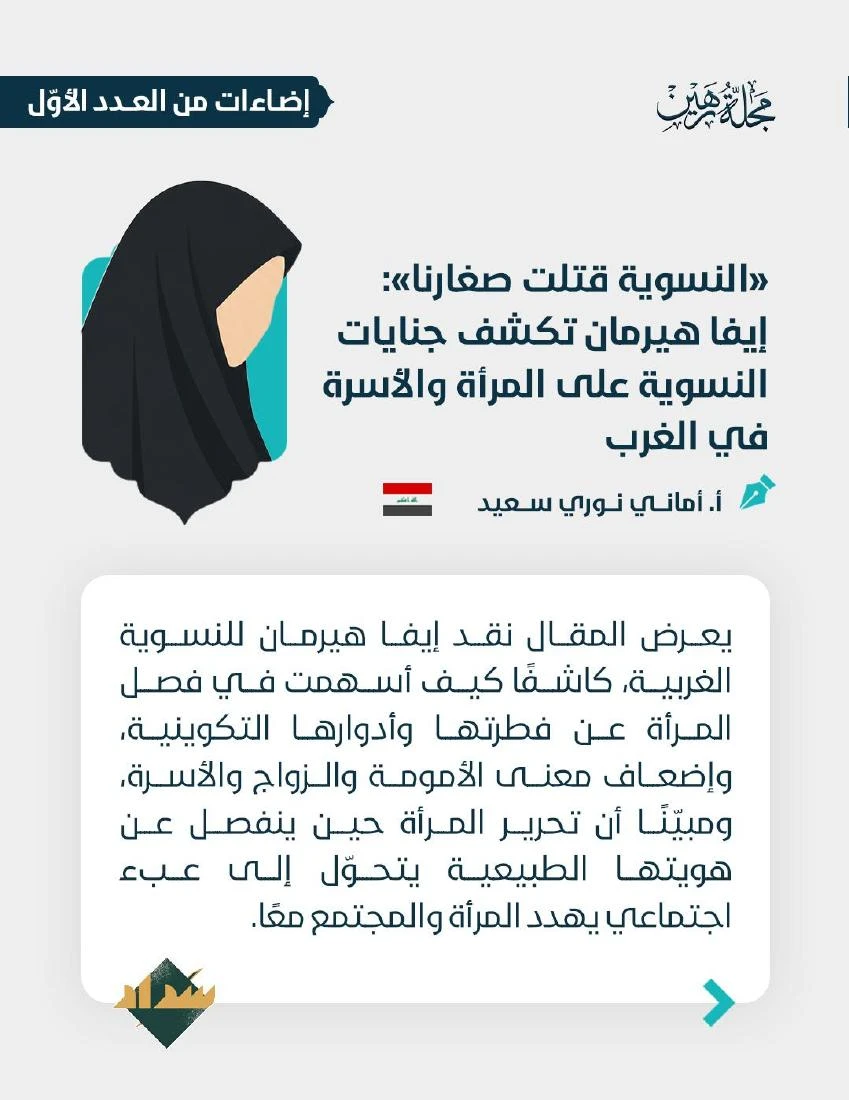
“Feminism Killed Our Children”: Eva Herman Exposes the Crimes of Feminism against Women and the Family in the West
This study examines the discourse of Eva Herman, the German anti-feminist writer, whose work has emerged as a counter-feminist revolution challenging the dominant trajectory of Western feminism. Herman argues that feminism has committed what she terms a “civilizational crime,” which she describes as the “killing of motherhood,” by depriving women from their natural disposition and alienating them from their feminine identity and authentic social roles. According to Herman, feminism has constructed a hazardous cultural framework that has cumulatively contributed to the rejection or postponement of marriage, the erosion of women’s desire for motherhood, and a profound decline in fertility rates—an outcome she encapsulates in her provocative assertion that “feminism has killed our children.” through the systematic displacement of women from their natural roles, particularly motherhood, which she regards as a fundamental biological and civilizational function essential to the preservation of the human species through reproduction. This paper explores, through Herman’s perspective, the repercussions of feminist ideology on women, the family, and society at large, focusing on her oppositional thesis as has been demonstrated in her influential book The Eva Principle. It further analyzes the major ideological contradictions and what Herman identifies as false conceptual assumptions underlying contemporary feminist thought, including the marginalization of motherhood, the redefinition of the family, and the impact of feminist policies on social structures. Methodologically, the study adopts a critical discourse analysis approach, drawing on a close reading of The Eva Principle, in which Herman offers a systematic and rigorous critique of contemporary Western feminist philosophies—particularly liberal and radical feminism—and how they view women and the family. The analysis is guided by the following research questions: What transformations has feminist thoughts introduced into the concepts of femininity, motherhood, and the family? How have these transformations affected the family and society? And what are the broader implications of these changes for civilizational structures and collective identity? The study concludes that Herman’s critique of Western feminist ideology constitutes a call to reassert the concept of the “traditional family” by establishing a more balanced framework that safeguards women’s original roles while reaffirming the centrality of the family and its social function in the context of the far-reaching consequences of Western modernity.