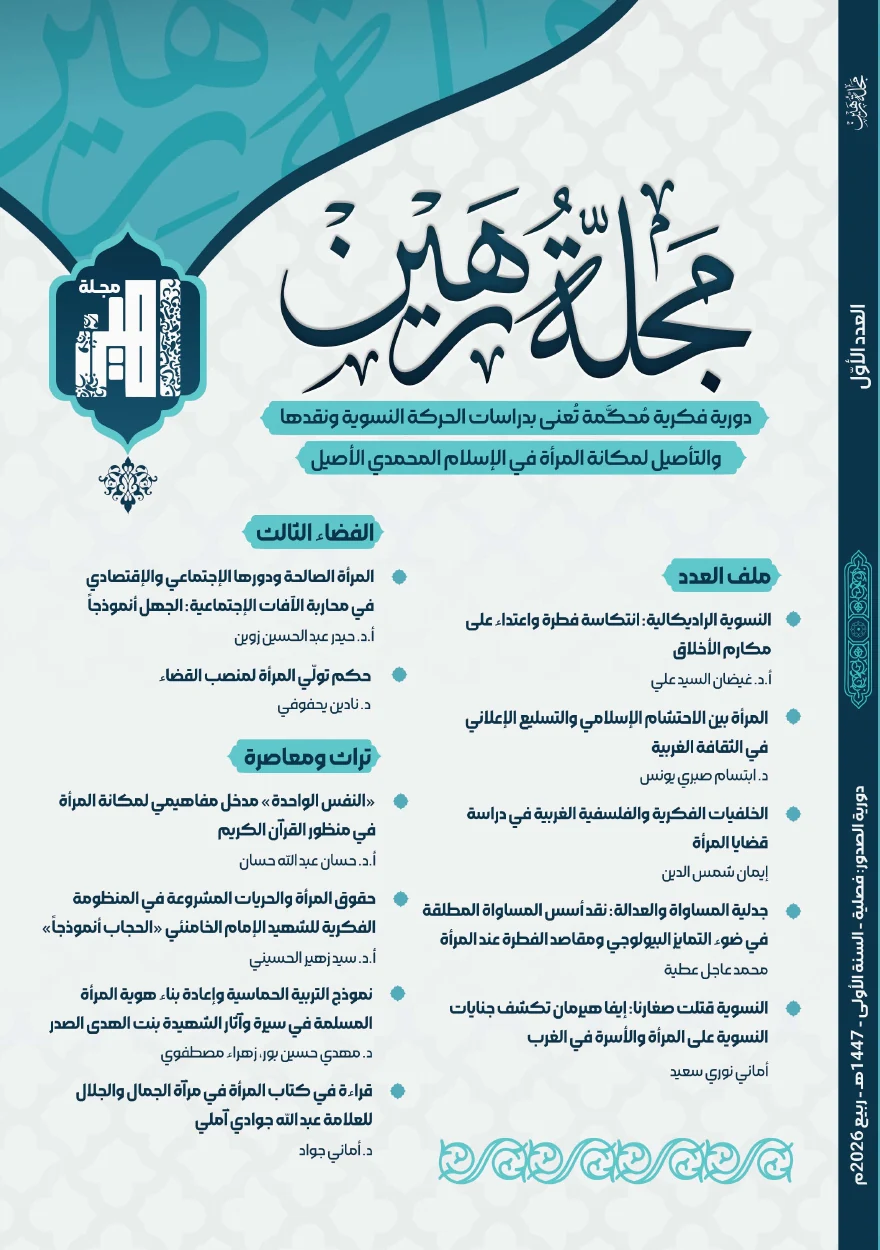
Editorial
Dr. Nadine Yahfoufi
Editorial
Editor-in-Chief, Dr. Nadine Yahfoufi
In the name of God, the Most Compassionate, the Most Merciful.
We live in a time of competing concepts, when ideas about the human person are being recast apart from the innate disposition (fitra) and divine frame of reference. Women’s issues have become especially prominent in contemporary intellectual and cultural discourse. They concern human beings and society as a whole and are central to debates about identity, fitra, the family and humanity’s role in civilization.
Rahin is published by the Sadad Islamic Center for Strategic Studies to provide a forum for rigorous scholarship on women’s issues from an authentic Islamic perspective. It seeks to articulate the place of women in the original Islamic teachings of the Prophet Muhammad. It questions fragmentary readings that reduce women’s lives to conflict with men, rebellion against the family or imitation of a Western model as the sole measure of liberation and dignity.
Rahin takes a reasoned, systematic approach to Western feminism and its transformations. The journal examines the philosophical premises, historical circumstances and social changes that produced contemporary feminist discourse, avoiding impulsive reactions and unreasoned rejection. It gives particular attention to critiques of what is called “Islamic feminism” when it conflates concepts or reinterprets texts and tradition through methods at odds with the spirit and original purposes of Islam.
Through its research and thematic sections, the journal opens space for sustained inquiry into fitra and femininity, identity, the family, the dignity God has bestowed on women and Islamic models of empowerment. It also studies classical and contemporary intellectual work on women’s issues and considers how that work has shaped social awareness and discourse.
We believe the Islamic view of women accords them human dignity, a share in the responsibilities of the religious mission and a central role in the renewal of the family, society and the Muslim community. Women are not peripheral to society or subordinate beings whose worth is set by the market, their bodies or adversarial competition. Renewing attention to a balanced Islamic model of womanhood means drawing on enduring principles to develop a contemporary awareness capable of addressing conceptual confusion and cultural distortions. It need not treat the past as a closed era to which we must return.
Rahin welcomes researchers and writers committed to serious scholarship. Together, we seek a well-grounded intellectual discourse that moves past passing disputes to establish foundations and past reactive positions to develop a considered outlook. The journal treats women’s issues as part of a comprehensive Islamic civilizational project that restores meaning to human life, a central role to the family and balance to society.
We ask God to bless this journal as a step toward knowledge and insight, a forum devoted to truth and a renewal of an authentic Islamic vision. Responsible speech, rigorous research and awareness of the religious mission are especially needed in our time.
Issue 1Ghaydan al-Sayyid Ali
Radical feminism is an extreme, revolutionary feminist movement that claims to revolt against the oppression of women by men under the “patriarchal system,” which subjugates them and reduces them to mere physical objects for exploitation and domination. According to this radical feminist ideology, men are both responsible for the exploitation of women and the beneficiaries of this situation. This extremist movement then called for a declaration of hostility between the sexes, a declaration of war against men, and saw the difference between men and women as a cultural and ideological difference and not a biological fact. This movement also called for the destruction of the family as the institution in which women are oppressed and subjugated and rejected motherhood and childbirth. It also called for homosexuality and deviance, complete feminist independence from men, and women’s freedom over their bodies, which permitted abortion and sexual practices outside of marriage. Influenced by post-modernism philosophy, she called for the relativity of values, making individual desire the standard of behavior, which makes it a call capable of creating a state of chaos in values and obliterating the features of pure instinct in human souls. The pioneers of this movement also called for the rejection of revealed religions and the invention of a new religion in which women are deified and homosexuality becomes its most important ritual. This made it a movement that does not aim to liberate women or seek any rights for them, but rather an extremist tendency that represents a regression from sound human nature and an assault on moral values.
Issue 1Ibtisam Sabri Younis
This study aimed to analyze the image of women between the Islamic model of modesty and the phenomenon of advertising commodification in Western culture, considering them as two models that differ in principle and purpose. The study started from the premise that modesty in Islam is not merely an external appearance but rather an integrated value system that elevates the dignity of women and limits their reduction to the body or appearance. In contrast, advertising commodification, as a product of the development of the Western media and consumer industries, transforms the woman’s body into an attractive tool that is commercially exploited in the contexts of advertising and marketing. The study adopts the descriptive-analytical method to trace the intellectual roots of both models, in addition to the comparative method to observe the fundamental differences between them in terms of reference, practice, and effects. It also benefits from the analysis of selected examples from contemporary Western advertising content, with the aim of revealing the mechanisms by which the image of women is invested in visual discourse. The results showed that Islamic modesty helps to establish an image that respects women’s humanity and grants them a social presence based on competence and role, while advertising commodification, in many cases, leads to the perpetuation of patterns of visual objectification and psychological pressure associated with standards of beauty and seduction.
Issue 1Iman Shamseddin
Understanding the foundations of epistemology significantly enhances an individual’s ability to distinguish between various forms of knowledge and their origins. Furthermore, it provides the intellectual depth necessary to grasp the reality of numerous concepts and theories that evolve into social phenomena through targeted promotion—processes that aim not only to influence but to actively construct human perception and consciousness. The linguistic overlap (verbal homonymy) found in many terms does not inherently imply a shared semantic meaning. Consequently, epistemology serves as the fundamental point of departure for all fields of knowledge, given its critical role in shaping intellectual structures and its capacity to diagnose the radical differences inherent in the nature of contemporary discourses. Perhaps one of the most prominent areas where the importance of epistemological inquiry is manifest is the “woman question.” This subject has remained a focal point of concern throughout history, owing to the pivotal role and status of women within both the family and the broader social fabric. This study—in its first volume—elucidates the significance of epistemology and its instrumentality in analysing feminist movements. It explores the fundamental differences in conceptual and semantic frameworks between the West and the East, specifically the Islamic East. This analysis accounts for the evolution of the feminist perspective in the West, the catalysts that led to its emergence, and the various factors that facilitated its dissemination and promotion.
Issue 1Muhammad Ajil Atiyah
The dichotomy of “Equality” and “Justice” represents the core problematic in contemporary feminist discourse. Modern and post-modern currents have sought to entrench the concept of “Absolute Mathematical Equality” as the sole standard for doing justice to women, thereby overlooking the formative facts and innate differences between the sexes. This research aims to deconstruct the philosophical and cognitive pillars upon which claims of total identicalness rest, employing a critical analytical methodology that combines Islamic legal (Shar’i) rooting with material scientific evidence. The study proceeds from the hypothesis that imposing “Mechanical Equality” amidst established formative and psychological differentiation between men and women constitutes a form of “masked injustice.” It forces women into a normative male model, alienating them from their authentic nature (Fitrah). In its argumentation, the research relies on data from neuroscience and biology, which demonstrate the deep-rootedness of creational differences, thereby refuting imported theories claiming that femininity and masculinity are merely “social constructs” unrelated to nature. Conversely, the research presents the Islamic model based on the principles of “Justice” and “Functional Complementarity” as a strategic alternative. It highlights how Islamic legislation respects the physiological and psychological specificity of women in the distribution of rights and duties. The study concludes that restoring the concept of Justice, rather than formal Equality, is the only path to ending the state of “psychological alienation” for contemporary women and rehabilitating the family institution as an incubator for tranquility and affection, rather than an arena for competition and peer conflict.
Issue 1Amani Nuri Saeed
This study examines the discourse of Eva Herman, the German anti-feminist writer, whose work has emerged as a counter-feminist revolution challenging the dominant trajectory of Western feminism. Herman argues that feminism has committed what she terms a “civilizational crime,” which she describes as the “killing of motherhood,” by depriving women from their natural disposition and alienating them from their feminine identity and authentic social roles. According to Herman, feminism has constructed a hazardous cultural framework that has cumulatively contributed to the rejection or postponement of marriage, the erosion of women’s desire for motherhood, and a profound decline in fertility rates—an outcome she encapsulates in her provocative assertion that “feminism has killed our children.” through the systematic displacement of women from their natural roles, particularly motherhood, which she regards as a fundamental biological and civilizational function essential to the preservation of the human species through reproduction. This paper explores, through Herman’s perspective, the repercussions of feminist ideology on women, the family, and society at large, focusing on her oppositional thesis as has been demonstrated in her influential book The Eva Principle. It further analyzes the major ideological contradictions and what Herman identifies as false conceptual assumptions underlying contemporary feminist thought, including the marginalization of motherhood, the redefinition of the family, and the impact of feminist policies on social structures. Methodologically, the study adopts a critical discourse analysis approach, drawing on a close reading of The Eva Principle, in which Herman offers a systematic and rigorous critique of contemporary Western feminist philosophies—particularly liberal and radical feminism—and how they view women and the family. The analysis is guided by the following research questions: What transformations has feminist thoughts introduced into the concepts of femininity, motherhood, and the family? How have these transformations affected the family and society? And what are the broader implications of these changes for civilizational structures and collective identity? The study concludes that Herman’s critique of Western feminist ideology constitutes a call to reassert the concept of the “traditional family” by establishing a more balanced framework that safeguards women’s original roles while reaffirming the centrality of the family and its social function in the context of the far-reaching consequences of Western modernity.
Issue 1Hassan Abdullah Hassan
This article aims to establish the foundational concepts of women in the Quranic perspective, in contrast to the secular concepts upon which contemporary feminist trends are based. These trends have transformed “woman” into a “gender” issue, removing her from the social sphere of the family and community membership, and placing her as an independent issue in opposition to the rest of society. The article’s methodology relies on the Holy Quran as the primary source for constructing foundational concepts that address the challenges of feminism in contemporary reality. We primarily focus on building an overarching concept: the concept of “the single soul,” which underpins the Quranic view of the entire human creation. Related to this concept are other related concepts, which we will explore, specifically the concepts of “the womb” and “marriage”. The article is divided into three sections: Section One: Background on the aims of the feminist movement in the West and some of its outcomes. Section Two: Basic premises of the Quranic perspective on women. Section Three: Some concepts of women in the Quran and their social and civilizational roles.
Issue 1Sayyid Zuhair al-Misilini
This study aims to explore the place of women’s rights and legitimate freedoms in the intellectual framework of Imam Khamenei, focusing on the issue of hijab as a case study. It seeks to clarify his vision in contrast to Western liberal and feminist discourses, highlighting the distinction between “freedom” and “legitimate freedom” in this context. This research employs a descriptive-analytical approach. Data were collected through a library study and qualitative content analysis of Imam Khamenei’s speeches, statements, and writings over an extended period. The findings reveal that, from Imam Khamenei’s perspective, hijab is not defined as a restriction, but rather as a “protective” factor and a key to women’s active and secure presence in various social, political, and cultural spheres. Legitimate freedom, in this framework, signifies liberation from “objectification” within the capitalist system and the attainment of true human dignity and identity. This article systematically extracts and analyzes the vision of the Leader of the Islamic Republic of Iran on women’s rights and hijab, a topic that has not been adequately addressed in international journals. This study offers a new framework for Islamic dialogue on women’s rights through a methodology that integrates Islamic, gender, and political studies.
Issue 1Mahdi HosseinpourZahra Mustafavi
The identity crisis of women in contemporary Islamic societies is a product of the debilitating conflict between two reductionist currents: traditional rigidity and modern alienation. This has ultimately led to the erosion of Muslim women’s agency and their isolation from their missionary role. This study seeks to offer a radical solution to overcome this identity impasse by examining and extracting the model of zealous education in the thought and struggles of the martyr Bint al-Huda al-Sadr. The central research question revolves around how the components of zealous education in al-Sadr’s school of thought contribute to the reconstruction of women’s identity, transforming them from passive recipients into active agents driven by a sense of missionary responsibility. The research employs a descriptive-analytical approach, utilizing content analysis to systematically examine the narratives, articles, and biography of the martyr. The research findings indicate that Bint al-Huda’s model of zealous education rests on three overlapping layers: 1. The verbal layer (successionist anthropology): which establishes existential self-respect as a cornerstone of women’s identity through a reinterpretation of the divine role of stewardship. 2. The cognitive layer (strategic awareness): which, through fostering critical insight, creates a formidable barrier against Western cultural hegemony. 3. The sociological layer (missionary resistance): which links familial roles with zealous jihad, transforming women’s social presence into a tool for shifting the balance of civilizational power. The study concludes that the martyr Bint al-Huda, by harnessing literary energies and confrontational educational management, was able to elevate women’s identity from a state of defense to one of influence and inspiration, culminating in the ultimate goal of conscious sacrifice. This model, beyond being a historical experience, offers a contemporary educational framework for preserving the identity and effectiveness of Muslim women in the face of intellectual invasion and the identity crises of the present era.
Issue 1Haider Abd al-Hussein Zwayn
The virtuous woman occupies a prominent social position in all societies of developed nations, particularly in the civilized world, due to her significant and vital responsibilities. Based on the importance of her role, this research aims to define the character of the virtuous woman in Islamic society, highlighting her attributes, qualities, and essence. It also focuses on demonstrating the social role of the virtuous woman and then her economic role. Furthermore, it emphasizes the importance of her role in society through combating prominent social ills, especially ignorance and backwardness. The study concluded that virtuous women are an essential element of society, indispensable and ineligible. Marginalizing virtuous women is tantamount to marginalizing and excluding human principles. They constitute half of society and are agents of change; without active, virtuous women, society is incomplete and lacks a true human identity. The research employed a descriptive-analytical approach, describing the virtuous woman and her essence, then outlining her roles, analyzing these roles, and demonstrating their impact on society in combating ignorance and backwardness.
Issue 1Nadin Yahfoufi
The judiciary is considered a sensitive and important position to which Islamic law has given great attention. It stipulates conditions that must be met by a judge, and the condition of being male is one of the conditions that has been the subject of debate. Consequently, this condition is seen as preventing women from assuming this position. The prevailing opinion among the Imamiyyah is that women are not permitted to hold this position, and its proponents rely on several pieces of evidence from the Quran, Sunnah, and consensus. However, each piece of evidence individually is not conclusive in its implication of the desired conclusion, but rather supports it. Therefore, another opinion emerged, which holds that women are permitted to hold the position of judge, since there is no established prohibition, even theoretically. The research concluded that the more correct opinion is that women are not permitted to hold this position, and that the position of judge is exclusive to men. This is because the supporting evidence, along with specific narrations that support the general application of the evidence, the spirit of Islamic law, and the widespread acceptance of this condition among jurists, constitutes evidence against women holding this position. This prohibition is, however, a mercy for women and not a diminution of their status.
Issue 1Amani Jawad
In an age in which women are viewed from a materialist liberal perspective, stripped of their spiritual and divine dimension, and denied attention to their true identity, some of the deepest blows to that identity have, in the author's view, been struck under the banner of defending women's rights. This study turns to Ayatollah ‘Allama Javadi Amoli, a philosopher of the divine who approaches questions from a profound monotheistic perspective. He brings together the Qur’an, rational demonstration, and Islamic mysticism to offer an encompassing account of existence and the human being. One of his principal works on women is Zan dar Ayeneh-ye Jalal va Jamal, translated into Arabic by Khalil ‘Isami and edited and checked by Shaykh Muhammad ‘Abd al-Mun‘im al-Khaqani. The 452-page Arabic edition, Women in the Mirror of Majesty and Beauty, introduces Arabic readers to women as signs of divine beauty and manifestations of perfection in existence. Beyond a social or legal account, Javadi Amoli develops a monotheistic perspective on how God regards women, drawing on Qur’anic verses, transmitted traditions, and mystical and demonstrative inquiry. The book distills lectures he gave at Al-Zahra University in Qom to women studying at advanced levels in the rational and transmitted sciences. An introduction explains the book's title. Its four chapters are ‘Women in the Qur’an,’ ‘Women in Islamic Mysticism,’ ‘Women in Rational Demonstration,’ and ‘Responses to Objections.’